

CASTLE/SLOTTED NUT

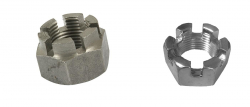
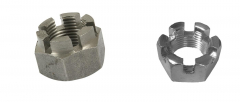
Castle and slotted nuts are specialized hexagonal fasteners designed with deep notches (slots) that allow them to be locked into place using a cotter pin, safety wire, or R-clip.

While they serve the same fundamental purpose of preventing a nut from loosening under vibration, their physical design and specific use cases differ slightly.

Key Differences

The primary distinction lies in the shape of the top section where the slots are located

  • Design Profile: A castle nut features a raised, rounded "turret" section that is narrower than the hexagonal base. A slotted nut is essentially a standard hex nut with slots cut directly into its flat top surface, meaning the slots span the full width of the hex flats.
  • Nut Height: For the same thread size, castle nuts are typically taller than slotted nuts because of their added turret.
  • Pin Security: The narrowed turret of a castle nut allows the legs of a cotter pin to be wrapped tightly around the rounded section, preventing them from protruding and catching on other parts. Slotted nuts do not provide this advantage.

Common Uses

  • Both types are "positive locking" devices, meaning they cannot spin off once the pin is installed, making them essential for moving parts.
CASTLE/SLOTTED NUT

Price Unavailable

UNC

Price Unavailable

UNF

Price Unavailable

Price Unavailable

BSF

Price Unavailable