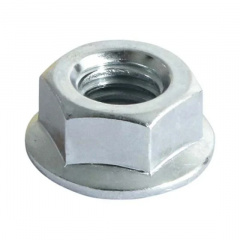
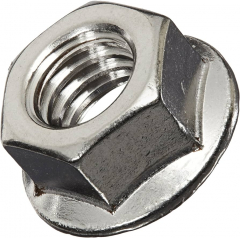
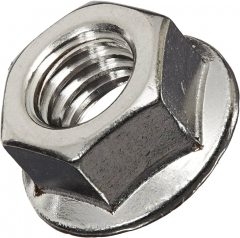
A hex flange nut is a hexagonal fastener with a wide, built-in circular base (the flange) that acts as an integrated washer.
This design eliminates the need for a separate flat washer, simplifying assembly and ensuring the washer face is as strong as the nut itself.
Plain vs. Serrated Flange Nuts
The choice between plain and serrated types depends on whether you need a smooth clamping surface or a locking mechanism.
- Plain (Non-Serrated) Flange Nuts:
- Surface Protection: These have a smooth underside and are used when you want to avoid marring or scratching the mating surface.
- Uniform Clamping: They provide excellent load distribution across a wide area, making them ideal for softer materials or irregularly shaped holes.
- Common Standard: Often manufactured to DIN 6923 specifications
- Serrated Flange Nuts:
- Vibration Resistance: The underside features angled teeth (serrations) that bite into the mating material to prevent the nut from backing off under vibration.
- Ratchet Action: The serrations are angled so that less torque is required to tighten them than to remove them, creating a ratchet-like locking effect.
- Considerations: They should not be used with a separate washer (which would negate the locking teeth) or on painted/coated surfaces where scratching could lead to corrosion.
Core Benefits
- Load Distribution: The wide flange spreads clamping pressure, reducing the risk of crushing or damaging the connected part.
- Efficiency: Using one piece instead of two (nut and washer) speeds up assembly and reduces the risk of incorrect installation.
- Material Options: Common materials include A2 or A4 stainless steel for corrosion resistance and zinc-plated hardened steel for high-tensile applications.