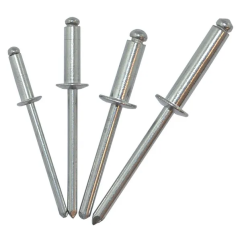
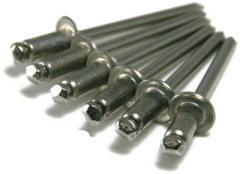
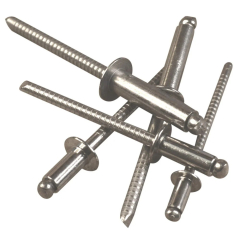
Blind rivets, also known as pop rivets, are two-piece mechanical fasteners consisting of a hollow body (the sleeve) and a central mandrel (the pin).
Their defining advantage is that they can be installed with access to only one side of a workpiece, making them ideal for hollow or enclosed structures.
How They Work
The installation process is nearly instantaneous, usually taking only a few seconds:
- Insertion: The rivet is placed into a pre-drilled hole.
- Pulling: A riveting tool grips the mandrel and pulls its head into the rivet body.
- Expansion: As the mandrel head is pulled, it causes the blind side of the rivet body to expand and clamp the materials together.
- Breakage: Once the maximum clamping force is reached, the mandrel snaps off at a predetermined "break point," leaving the rivet permanently set.
Critical Selection Factors
Choosing the right blind rivet depends on the total thickness of the materials being joined and the environment.
- Grip Range: This is the most important measurement—it refers to the total thickness of the materials you are joining.
- Rule of Thumb: A rivet should be at least 1.5 times longer than the grip range to ensure proper secondary head formation.
- Under-gripping: If a rivet is too long for the material, it may wobble or leave too much waste.
- Over-gripping: If the rivet is too short, it will fail to grip the material securely.
- Material Compatibility: To prevent galvanic corrosion, try to match the rivet material to the material being joined (e.g., use aluminium rivets for aluminium sheets).
- Aluminium: Lightweight and corrosion-resistant; best for general tasks.
- Steel: Stronger and suited for heavy-duty, load-bearing structures.
Stainless Steel: The strongest standard option; highly rust-resistant and ideal for outdoor or marine use.